Showing posts with label RAI. Show all posts

Sunday, October 7, 2012

Heterotaxy RAI vs LAI


(While reading this entry, please remember I am not a medical professional.  Also keep in mind that heterotaxy is as different as every patient.  Some individuals may have all the conditions described, or very few.  This is just a guide for basic understanding.)

I felt like I should bring in a special guest illustrator for this post.  Maybe I was a bit ambitious, but I enjoy giving others a chance, especially when the artist has life-long experience with heterotaxy.  At first he was eager, quickly sketching how the internal organs might look, he was very intense.


Then, he went all “diva” on me, demanded breastmilk, a cookie and a nap, whining something that sounded a lot like “I can’t possibly work under these deplorable conditions”.  Of course, I was forced to tuck 16 month old Alexander into his bed and go on without him, even though I think there may be some degree of accuracy to his unfinished drawing.

Humor aside, there are days when his scribbles make me think of heterotaxy.  The literal translation of heterotaxy is “different arrangement”.  There is not a consensus on exactly how that applies, but many feel that the heart is always involved (though, perhaps not to a great degree), and there is some abdominal ambiguity.

Looking at a person from the outside, it’s hard to imagine the complexity that lies on the inside.  Generally speaking, the outside appearance of a person is symmetrical between the left and right side.  A person’s arms are about the same size and length, their feet are about the same size, and the ears are near the same spot.  The left side is much like a mirror image of the right, or vise versa.

On the inside it’s the opposite.  The left side is completely different from the right.  The stomach is on the left side of the body, the liver on the right.  Even paired organs that have one organ on each side of the body are structurally different from each other.  For instance the left lung only has two lobes, while the right has three and the right adrenal gland is triangular shaped and the left horseshoe shaped.


Heterotaxy disrupts this asymmetrical balance.  During the early days of a pregnancy (between the 3rd and 6th week) the internal organs are forming.  They are created from tubes of tissue that are told how to twist and turn to form the intricate chambers of the heart, blood vessels and digestive tract.  In heterotaxy, these twists and turns don’t happen the way they should, and it’s not entirely understood why.  There are some genetic markers that indicate inherited heterotaxy, and sometimes the syndrome does run in families.  There is also some evidence that heterotaxy (whole or in part) could be related to Primary Ciliary Dyskensia (PCD) which affects the ability of tiny hairs (cilia) in our bodies to move things around they way they should.


Most cases of heterotaxy can be organized into two types.  There is Left Atrial Isomerism (LAI) and Right Atrial Isomerism (RAI).  To better understand what is happening, it helps to know the definition of isomerism.  Isomerism is a chemistry term that describes different compounds that are made up of the same parts (atoms), but they are bonded together differently, and that makes the compound completely different.  The use of isomerism when referring to heterotaxy describes optical isomerism, or when those compounds are arranged in such a way they are the mirror images of the other.

Remembering from earlier, think of the outside of our body as optically isomeric; it is made up of the same parts, but in a mirror image to the other.  However, the inside isn’t supposed to be, as there are drastic differences between the right and left internal organs. Therefore, in RAI, all the parts of the right side are present, but mirror imaged to the left, and in LAI all of the left-sided structures are there, but mirror imaged to the right.  This isn’t perfect, but it does help when knowing what to expect from a RAI patient versus a LAI.

In RAI, the structures of the heart are usually greatly affected.  Much of the heart lies on the left side of our bodies, so it makes sense that when the right side of the body is copied, the heart would suffer.  The lungs often end up as two tri-lobed lungs (as the right lung is tri-lobed), the stomach is on the right side of the body versus the left, the spleen is generally absent (asplenia).  The liver usually becomes transverse (midline) and the gall bladder can be affected, and the intestines are often malrotated and the kidneys and adrenal glands can suffer some anomalies.

In LAI one can almost infer the opposite to be true.  The heart tends to have less structural problems, but more prone to electrical ones as the heart’s natural pacemaker is located in the right atrium.  Often, the lungs are both bi-lobed (and bi-lobed lungs are slightly smaller than tri-lobed).  The liver can be midline and malrotated intestines might be present.  Many patients have polysplenia (or many spleens), and while one may think many is much better than none, often times they are not working.  This is known as functional asplenia.  Differences can also affect the kidneys and adrenals.

Because of how complex and extensive this syndrome is, every person affected is different.  One could talk to twenty patients and their families and hear twenty different stories and diagnoses.  These families have teams of doctors to help keep their children in the best possible health.  Our family has been fortunate that Alexander has been so well, but we’re also aware that the luck may not hold out forever.  Our hope is to continue to bring attention to this rare congenital syndrome.  Only through awareness can we convince people to care, and when enough people care change can happen.


I am not a nurse or doctor, nor have I received any formal medical training.  Any and all medical related information on Drawing Heart is the product of a mother’s desperation to understand and advocate for her child.  This blog is the culmination of countless hours of independent research and medical consultation and is meant only to communicate my understanding of Alexander’s condition.  It is not intended as medical advice.  As always, seek the advice of a qualified medical professional to explain your specific diagnosis.

Wednesday, September 19, 2012

Differences part 2


Because Alexander’s heart is complicated and I am wordy, I couldn’t quite keep the discussion about his heart in one post.  Drawing his heart, his anatomy, his condition has become very important to me.  I remember those first days when I was searching the web for “heterotaxy syndrome” and how little information would pop up.  I recall that most the articles were pitifully short and lacking details, or so in-depth I felt I needed a medical dictionary just to wade through the first paragraph.  Little more than a year later, that has changed for the better, and I want to continue the trend.  I want families to be able to understand Alexander’s diagnoses, and perhaps that would help them understand the ones they have been presented. 

Two Right Atria

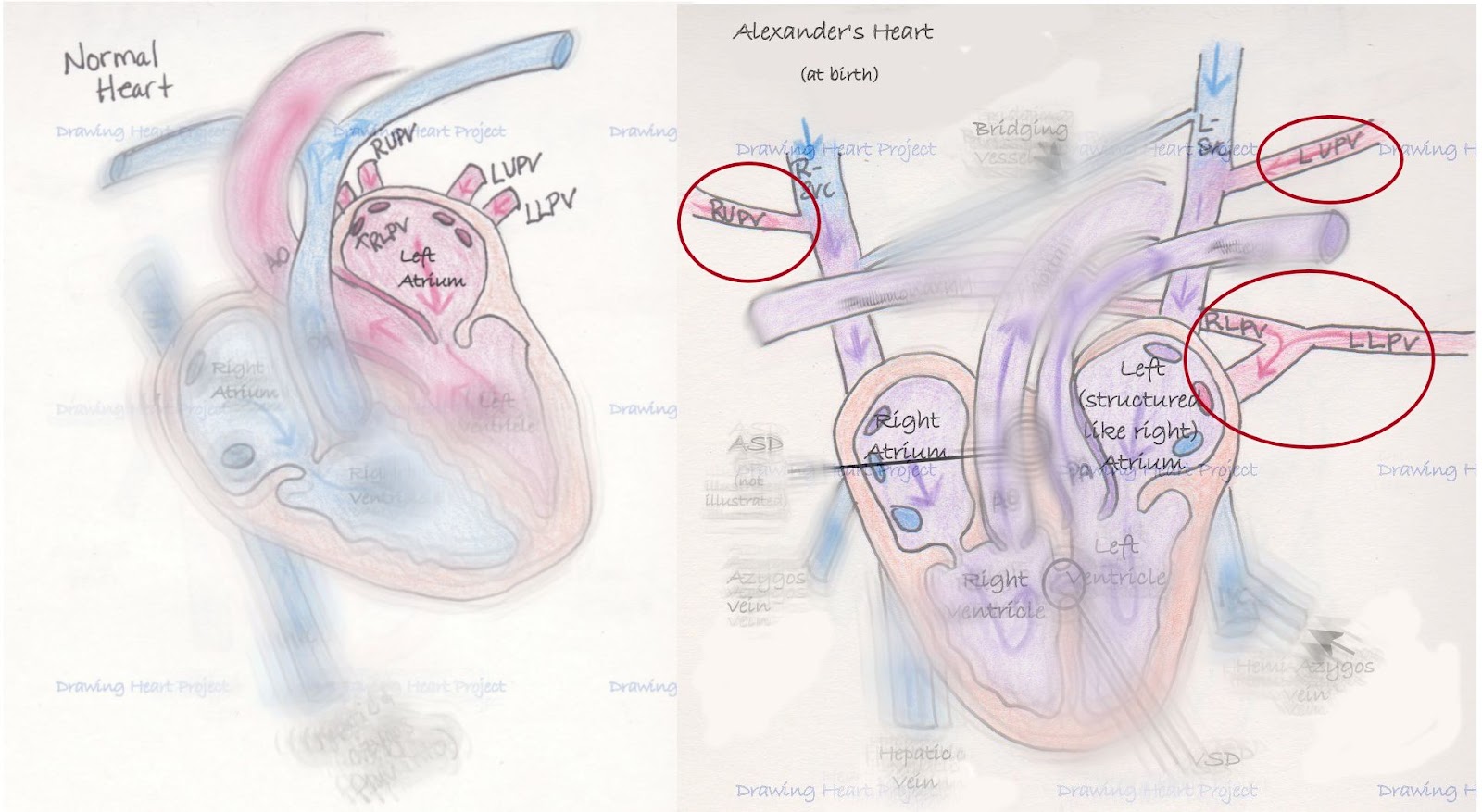
The right atrium and the left atrium are structurally different.  They are intended to match with their corresponding ventricle.  For instance, the electrical impulses that tell the heart to beat originate in the right, and the left side of the heart is higher pressure system.  In Alexander’s heart, the atrium on the left side of his body is structured like a right atrium.  Many doctors say this shouldn’t cause a problem; if he had two left, he might need a pacemaker.  However, it is something of concern to me.  Alexander is unusual that he will have a two ventricle repair.  Not many heterotaxy-RAI patients are so lucky.  But what is luck for his ventricles, there really is a lack of information on how well his left-sided atrium will hold up.

Atrial Septal Defect (ASD) and Ventricular Septal Defect (VSD)

The separating wall between the left and right side of the heart is known as the septum.  It is solid and keeps the blue blood from mixing with the red.  In utero, there is a small hole (foramen ovale) between the left and right atrium, but like the ductus arteriosis (DA) it closes soon after birth.  In Alexander’s case, it was larger than normal and did not close on its own.  Alexander also had a moderate sized hole between his left and right ventricles.  Sometimes these defects close on their own, but Alexander’s were considered to be too large for that to happen.


Left-sided Inferior Vena Cava (IVC)

There have been many times when I have been baffled by Alexander’s anatomy, but none surprises me as much as this defect.  The IVC is a right-sided structure.  It brings all the deoxygenated blood back to the heart from the lower part of the body.  It forms from the two iliac veins (one from each leg) and travels just right of the spine to the right atrium.  All of the lower body’s veins flow into it as it climbs upward.  Before entering the atrium, the hepatic veins from the liver flow into the IVC.


Alexander’s IVC is much different.  He has a true left-IVC.  It is to the left of the Aorta and spine, and both of the iliac veins flow into it.  It continues past the renal (kidney) level and flows along what is referred to as a hemi-azygos continuation.  It then flows into the left side of the heart with no interruptions.  Alexander’s hepatic vein connects directly to the right atrium and his azygos vein connects to the right atrium instead of the SVC.  If you look at the vascular structure of Alexander’s heart with little regard for labels, you can see how much the left mirrors the right.  While this anomaly by itself may not cause issue, the flow from the IVC must be routed back to the proper side of the heart and any surgeon that may operate on him need to know of his abnormal vasculature to avoid mistakes.


Partial Anomalous Pulmonary Venous Return (PAPVR)

The pulmonary veins bring oxygen rich blood back to the heart to be delivered to the body.  Each pulmonary vein (there are typically four, but can be more) independently attaches to the left atrium.


In Alexander’s anatomy, none of his pulmonary veins attach like they typically should.  However, three of four veins do drain into the left atrium.  His right lower pulmonary vein (RLPV) and left lower pulmonary vein (LLPV) come together in what is known as a confluence before draining into the left atrium.  The left upper pulmonary vein (LUPV) drains into the L-SVC which drains to the left atrium.  The right upper pulmonary vein (RUPV) is the problematic one.  It drains into the R-SVC which drains into the right atrium.  In a heart with all of its flow being normal, this would reduce the oxygenated blood around 25%.  It also causes an increased workload on the right ventricle by adding additional blood volume.

Alexander arrived with a special kind of heart.  He has certainly had his cardiac team on their toes learning about his system.  But Alexander has other anomalies, too.  The effects of heterotaxy are far and wide on his tiny system, as is usual with those with this condition.  His body is like a tiny puzzle, every piece must be scrutinized and fit together exactly right to function well. 

I hope that in my next post I can describe heterotaxy on more of a broad scale, helping others understand the scope of this terrible condition.

***I am not a nurse or doctor, nor have I received any formal medical training.  Any and all medical related information on Drawing Heart is the product of a mother’s desperation to understand and advocate for her child.  This blog is the culmination of countless hours of independent research and medical consultation and is meant only to communicate my understanding of Alexander’s condition.  It is not intended as medical advice.  As always, seek the advice of a qualified medical professional to explain your specific diagnosis.***

Saturday, September 8, 2012

Drawing Heart


***I am not a nurse or doctor, nor have I received any formal medical training.  Any and all medical related information on Drawing Heart Project is the product of a mother’s desperation to understand and advocate for her child.  This blog is the culmination of countless hours of independent research and medical consultation and is meant only to communicate my understanding of Alexander’s condition.  It is not intended as medical advice.  As always, seek the advice of a qualified medical professional to explain your specific diagnosis.***

 
From the moment Alexander was born he was making doctors ask questions.  Because of fetal imaging we knew he would be born with d-TGA (dextro-Transposition of the Great Arteries).  Traditionally, these infants have been called “blue babies” as the circulation did not allow oxygen into their blood and to their bodies.  Alexander was born pink and continued to be.  Doctors knew something else must be occurring for him to be so well oxygenated.

Within hours, Alexander was the main attraction in the NICU/CICU.  Every doctor came to look at him, tons of imaging was done, nurses were constantly puzzled about his true condition.  We had one doctor that consistently drew pictures for the other staff, trying to communicate Alexander’s entire heart status.  Terminology was constantly thrown out, and Matt and I weren’t nearly as educated on the topic as we are now.

At eight days old, they prepared to take him into surgery for the first time.  The cardiac surgeon talked to us about his conditions and the surgical plan when he spoke the words that inspired this project.

“He’s unique; no other like him.  You won’t find a picture of his heart in a book or online.  He’s as rare as they come.”

That upset me.  How could I, a “normal” parent, understand when the doctors are not only delivering diagnoses that I’ve never heard of, made up of multiple words that each need a google search, but have no real illustrations to go with it?  How could I grasp Alexander’s entire condition “blindly?”

The answer was a long amount of time, a ton of research and, eventually, sketching his anatomy.  It brought a great amount of confidence understanding his condition and being able to communicate it.  I’ve found myself sketching the same heart pictures over and over, refining them, explaining his special heart to the newest doctor.

That brings me to now, and the project that’s known as “Drawing Heart” on my hard disk.  I realized that if I had trouble understanding Alexander’s condition, others must have as well.  I decided that I would draw the structures and conditions that have become so familiar to me in hope that others would be able to better understand by looking and reading my own interpretations.  My goal is to raise awareness and understanding for all things heterotaxy.

For now I’ll just leave my drawing of Alexander’s special heart when he was born(so now a picture of it can be found online!), but I will explain it in a later post.  I hope “Drawing Heart” brings attention and increases understanding.